Draws in Chess: The Rules, the Claims, and How to Train Them with Puzzles
A chess game doesn't have to end in checkmate to be over. Quite often, the correct result is a draw - sometimes because the board position forces it, sometimes because the rules allow it, and sometimes simply because both players decide that continuing isn't worth the risk.
This article is written as a practical guide for ChessPuzzle.net: you'll get clear definitions, example positions, what you do in over-the-board (OTB) tournaments versus online play, and how each draw type shows up in chess puzzles - especially in draw puzzles, where your whole job is to save the game.
Table of contents:
- Draw by mutual agreement
- Stalemate
- Impossible checkmate (dead position / insufficient mating material)
- Threefold repetition
- The fifty-move rule
- Draw puzzles on ChessPuzzle.net
OTB vs online in one sentence: under the FIDE laws of chess, some draws end the game immediately (e.g., stalemate, dead position), and some require a correct claim (threefold repetition, fifty-move). Two higher thresholds also exist — fivefold repetition and the 75-move rule — which the arbiter must declare when they occur, even without a claim. Online interfaces often replace "call the arbiter" with automatic draws.
Draw by mutual agreement
Definition. A draw by agreement is exactly what it sounds like: both players decide the position is drawn (or practically drawn) and agree to split the point. Under the FIDE Laws, this ends the game immediately.
Example position. Many symmetric rook endgames with all pawns on one side are objectively drawn, and players often agree rather than playing on.
How it is done OTB. In most events, the correct procedure is: offer the draw after you make your move on the board and before you press your clock. Many top level events restrict early draw offers (for example, you may need arbiter consent before a certain move number).
Stalemate
Definition. A stalemate occurs when the player to move has no legal move, and their king is not in check. Under the FIDE Laws, this immediately ends the game as a draw (as soon as the stalemate position is reached by a legal move).
Example position. Black to move is stalemated (no legal moves, not in check):
How this is claimed OTB and online. In OTB play, stalemate does not require a claim - it's simply the result once the position is on the board. In practice, players usually stop, verify, and the arbiter confirms.
Online, the server typically declares it automatically as soon as the position is stalemate.
On ChessPuzzle.net, you can practice stalemates in draw puzzles like this one:
You can practice stalemates in Puzzle Filter and systematically learn about stalemate motifs in Puzzle Academy.
Here is a video from this very nice stalemate finish between Hikaru Nakamura and Praggnanandhaa:
Impossible Checkmate (Dead Position)
A game is drawn by impossible checkmate if a position arises in which neither player can possibly give checkmate by any sequence of legal moves. Such a position is called a dead position.
In most cases this happens because there is insufficient material left on the board to ever checkmate the opponent's king. However, it can also occur in more unusual positions where pieces remain on the board but no legal sequence of moves could ever lead to checkmate.
Typical cases: Insufficient material
The most common dead positions are simple endgames where checkmate is mathematically impossible:
- King vs King
- King and Bishop vs King
- King and Knight vs King
- King and Bishop vs King and Bishop (when both bishops move on the same color squares)
In these endings, even the worst possible play by the opponent cannot lead to checkmate. As soon as such a position appears on the board, the game is immediately drawn.
Not every drawn endgame is automatically a draw under this rule. For example, king and two knights vs king is a theoretical draw, but it is not a dead position because checkmate can occur if the weaker side blunders. A recent example occurred at the 2026 Freestyle Chess World Championship, where Arjun Erigaisi continued playing a king and two knights vs king endgame against Javokhir Sindarov for dozens of moves before the draw was agreed.
More complex dead positions
A position can also be a dead position even when pawns or other pieces remain on the board. For example, a completely blocked position may arise where no pawn can move, no piece can be captured, and no progress toward checkmate is possible for either side.
Unlike insufficient-material cases, these situations are sometimes less obvious.
How the draw is declared (OTB vs Online)
- Over-the-board: The game is immediately drawn once a dead position appears. If the situation is unclear, players typically stop the clock and call the arbiter to verify the draw.
- Online and on ChessPuzzle.net: The draw is detected automatically by the system in the obvious cases. In the more complex cases, an automatic detection is usually not possible, and players will either agree to a draw, or if the game continues, it will end in a draw due to the position repeating, or the 50-move rule. Note that it is still possible to lose on time in these rare cases.
Here is a video from a game between Anish Giri and Magnus Carlsen, where a dead position (king and knight versus king) arises and the game is drawn:
Dead positions in chess puzzles on ChessPuzzle.net
Dead positions play an important role in chess training:
- Drawing puzzles: You may need to simplify into a position with insufficient material or force a dead position to secure a draw.
- Winning puzzles: You must avoid simplifying into insufficient material. For example, trading into King and Bishop vs King will not win.
These puzzles train an important practical skill: recognizing when material advantage is not enough to win, and knowing when to aim for or avoid simplification.
Example Drawing Puzzle
Threefold repetition
Definition. Under the FIDE Laws, a game is drawn upon a correct claim when the same position appears for at least the third time. - and the repetitions do not need to be consecutive. The positions count as "the same" only if: the same player has the move, the same pieces of the same colors occupy the same squares, and all legal-move rights are the same (including castling rights and en passant availability).
The most common example of a threefold repetition is the perpetual check, where one side gives a series of checks that forces the opponent to repeat the same position multiple times. Here is an example where White has sacrificed the queen, but can now force a draw by perpetual check:
Note that the FIDE rule explicitly allows for non-consecutive repetition: you can repeat position A, then make some different moves, and later return to the exact same position A again; it still counts as a repetition. This is important to understand because it means that the "threefold repetition" draw can be achieved in more complex ways than just a simple back-and-forth. The position must be repeated, not necessarily the moves.
In the 1972 world championship match between Bobby Fischer and Boris Spassky, in game 20 Fischer called the arbiter to claim a draw by threefold repetition. Spassky agreed to the draw before the arbiter could verify the claim, however it turned out that the claim was incorrect. While the position had repeated three times, it was not the same player's turn in all three instances, so the claim was invalid. Here is historical footage of that moment:
How to claim a draw by threefold repetition in OTB tournaments. Under FIDE rules, the proper ways to claim are:
- If the position is about to appear for the third time, you claim by writing down your intended move (that you cannot change) and declaring to the arbiter that you intend to make it.
- If the position has just appeared for the third time and it is now your move, you can claim immediately.
- Once you claim, the clock must be paused, and if the claim is wrong, you typically get penalized (the opponent gets extra time) and play continues.
In online play, and in puzzles on ChessPuzzle.net, there is usually no claim process. If the server detects that the same position has occurred three times, the game automatically ends in a draw.
The fifty-move rule
Definition. Under the FIDE Laws, the game is drawn upon a correct claim if the last 50 moves by each player have been made with no pawn move and no capture, or if you can make a move that will complete such a 50-move sequence.
Example position. In many pawnless endgames, the 50-move counter becomes the "hidden clock." A simple example is bishop + knight vs king: it is a theoretical win, but (in practical play) you still must execute it cleanly and efficiently.
In OTB tournaments the procedure to claim a draw mirrors threefold repetition:
- You may claim by writing down your intended move (that you cannot change) and declaring to the arbiter your intention, if that intended move would complete the required "no pawn moves / no captures" for 50 moves by each player.
- Or you may claim if the last 50 moves by each player have already been completed with no pawn move or capture.
- Once you claim, the chess clock is paused. If the claim is wrong, the opponent gets extra time and play continues.
In online play, and in puzzles on ChessPuzzle.net, there is usually no claim process. If the server detects that 50 moves have been made by each player without a pawn move or capture, the game automatically ends in a draw.
Here is video of an unusually dramatic example from a game between Hikaru Nakamura and Alexander Donchenko. Donchenko claims the 50-move rule draw right before being checkmated:
Draw puzzles on ChessPuzzle.net
Draw tasks are first-class training targets on chesspuzzle.net. The puzzle filter explicitly supports draw training, including "Stalemate," "Repetition," and "Insufficient material," plus endgame training draw tasks. In Puzzle Academy, the Defence and Endgame courses include many puzzles and training positions where your objective is to achieve a draw.
In addition to puzzles, ChessPuzzle.net also supports endgame training positions, including positions where you are down material and have to hold a draw. This includes many important endgames such as bishop versus rook, or pawn versus queen, where the defender's main task is to hold a draw by accurate defense. This often requires you to play correctly for many moves in order to claim a draw based on the 50 moves rule - literally practicing the real OTB skill of holding a position for a long time with accurate defense. As you saw in the above video of Donchenko vs Nakamura, even top grandmasters can find this difficult in practice, and it is a skill that is very important to train if you want to succeed in OTB tournaments.
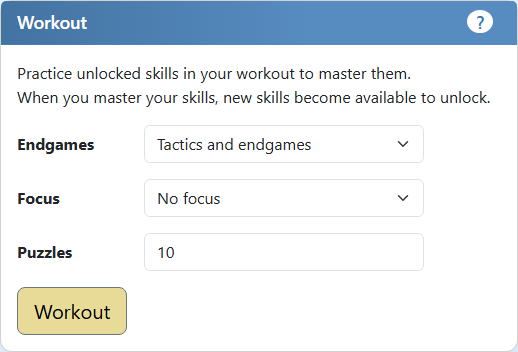
Some endgame training positions take a long time (including defending all the way to a 50-move-rule draw, or executing bishop+knight mate), so Puzzle Academy workouts let you choose between tactics, endgame, and mixed sessions. Pick "tactics only" when that's your focus, and you don't want to be surprised by 50 moves marathons.

Sunday, February 15, 2026
Last updated: Sunday, June 21, 2026
Martin Bennedik
Founder of ChessPuzzle.net, International Correspondence Chess Master
Related posts
How to learn and practice checkmates with Puzzle Academy
From the most important basic checkmate patterns to the most complex and beautiful checkmate combinations, Puzzle Academy helps you improve your checkmating skills step by step.About Ratings
Chess ratings and ratings on ChessPuzzle.net explained
The ChessPuzzle.net settings dialog
This article explains all options of the settings dialog.