Endgames
Why Endgames Matter
Endgames are the last phase of a chess game, where only a few pieces remain on the board. If you understand them well, you can win positions that other players only draw, save positions that look lost, and make better decisions much earlier in the game.
Many tactical puzzles end when you win material or force checkmate. Endgame training goes one step further: you learn how to convert the advantage, hold the draw, and make accurate decisions when every tempo matters.
Why you should practice endgames
Learning fundamental endgames is an important part of chess training, but it is not enough to read about them once and hope to remember them during a game. You need to practice the positions yourself, make decisions move by move, and build confidence in the key techniques.
The Puzzle Academy Endgames course lets you train these ideas through many practical examples. You will learn when a position is winning, when it is drawn, and what you actually have to do over the board to prove it.
Endgame training positions
Not every position in this course is a normal puzzle with one short tactical solution. Some are endgame training positions, where there can be several ways to win or draw, but the practical task is still difficult because you may need to play accurately for many moves.
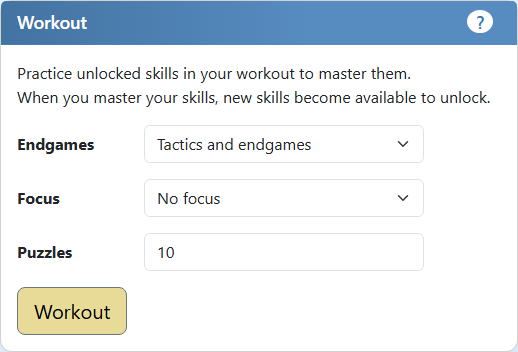
Some endgame training positions take a long time, including defending all the way to a 50-move-rule draw, or executing bishop and knight mate. Puzzle Academy workouts therefore let you choose between tactics, endgame, and mixed sessions. Pick "tactics only" when that's your focus, and you don't want to be surprised by 50-move marathons.
You can read more about endgame training positions in this blog post.
What you will learn
The Endgames course teaches practical endgame technique step by step. You will start with essential positions and continue toward more difficult endgames where precise calculation, good technique, and patience are required.
The following chapters are already available:
-
Endgames without pawns
- Checkmating with bishop and knight
- Rook versus knight
- Rook versus bishop
- Rook and bishop versus rook
-
Pawn endgames
- King and Pawn versus King
-
Queen endgames
- Queen versus pawn
- Queen versus rook
-
Minor piece endgames
- Knight versus Pawn
Forthcoming chapters
Work has started on the following chapters. Additional chapters are planned for the future.
-
Pawn endgames
- King and pawn versus king and pawn
-
Rook endgames
- Rook versus Pawn
- Rook and Pawn versus Rook
Examples
King and Pawn versus King
In simple pawn endgames, one tempo can decide everything. You will learn when to take the opposition, when not to take it, and how to recognize the defender's real route to the pawn.
In this position, the natural-looking 1.Kc5? takes the opposition, but it does not stop Black from reaching f7. This is the kind of detail you will learn to recognize: opposition is important, but it is not a magic rule. You also have to understand where both kings are going.
Click the diagram to solve the puzzle.
Queen versus pawn
Queen versus pawn can look simple, but some positions are drawn and others can be won only with accurate technique. You will learn when the stronger side can win, when the defender can hold the draw, and how to play the position correctly from either side.
In this example, Black must know the winning method. You will learn to bring the queen to the second rank with checks, then walk with the king to g6 at the right moment. Once you understand the technique, you can convert positions that might otherwise feel impossible to win.
Click the diagram to practice this endgame.
Rook and pawn versus rook
Rook endgames are some of the most important practical endgames in chess. You will learn the defensive setups that save half-points, and the attacking methods that try to break them.
One of the most important defensive setups is the Philidor position. If you know it, you can often draw a rook-and-pawn-against-rook endgame that many players would lose.
The defender's king stands in front of the pawn, and the rook controls the third rank. This prevents the attacking king from advancing and supporting the pawn.
You will learn the key moment: wait with the rook on the third rank until the pawn advances to the third rank. Then move the rook behind the pawn and give checks, for example: 1.Rg3 d3 2.Rg8 Kc3 3.Rc8+
The attacking king has no shelter from the checks. If the king moves back toward the rook, the defender can eventually attack and win the pawn. This is the kind of practical defensive technique that can save games even against strong opponents.
Development note
This course is still in development. Many guides are available now, but the course does not yet include guides for every topic. Also remember that you can lock any unlocked skills if you change your mind.
Intended audience
After the course has been in beta for some time, the current difficulty ratings range roughly from 1300 to 2200. That means the course starts with essential practical endgames, but also reaches positions that require accurate technique and serious calculation.
If you are still learning basic endgames, this course will help you build the foundations. If you are already a stronger player, the more advanced levels will help you sharpen your technique and avoid costly mistakes in positions with only a few pieces left.